

Bryan Foley is our club archivist and a regular contributor to this blogpost. If you have interesting tidbits to share or early guidebooks to donate, please get in touch with Bryan
Last month I shared with you the early beginnings of the Dufferin Hi-Land BTA ( BTC ) This month I thought I would start at the beginning of the section km o.o at Mono Centre, historically.
Settlement of the area around Mono Centre began in the 1830’s. Robert Large, one of the first arrivals, began farming in the area. Nearly the whole of the township was a howling wilderness.
There were scarcely any clearings, nor were any trees cut, except those cut along the lines of the government surveys. Shortly after he arrived, Mr. Large wrote to Messrs Curry, Laidlaw and Turnbull, telling them the best places to select their land.
They arrived about 1835. Mr Curry settled on the east half of Lot 18 cons 3 EHS, Mr Large being on the west side of the same lot. Mr Laidlaw took up residence on Lot 19 cons 3 EHS and Mr Turnbull Lot 19 cons 2 EHS
In the following year the settlement grew with the addition of Andrew Henry, John Still, Peter Stewart, Joseph Lundy, the Partridge, Buchannan and the Laverty family. Mr Still had 8 sons , settled on cons 4 EHS. Mrs. Stewart and Mrs. Still were sisters. The Stills made their home at the Stewarts until they got their own home built.
That summer before the house could be completed, Mrs. Still died. She left a baby which was reared by Mrs. Stewart. Mr. Stewart was a blacksmith and erected a small shop on Mr. Laidlaw’s farm building a larger more complete smithy on his own farm Lot 20 cons 4 EHS.
The Laidlaws also met with misfortune. One day when Mrs. Laidlaw was out on errands , the house burned to the ground together with all their contents and a sum of money.
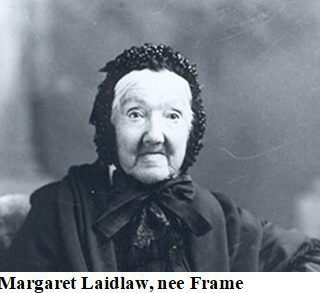
Mrs. Margaret Laidlaw
Mrs. Laidlaw, whose maiden name was Margaret Frame, was born in Scotland on February 2nd, 1803, and when nineteen years of age she came to America, landing at New York, where she lived until 1825, when she married Alex Laidlaw. After two years’ residence at Le Roy, New York State, they moved to Rochester, where they conducted a market garden very successfully. William Large, a brother-in-law, who had been to Toronto (or York, as it was then called), had secured 500 acres of land at what is now known as Mono Centre. Of this, 200 acres was made over to Alex Laidlaw and 100 acres to John Turnbull. It was about Christmas of the year 1832 that David Currie, having been unfortunate in the purchase of some property in the States, arrived at the Laidlaw home in Rochester with his wife and two children, on their way to Canada, and persuaded Mr. and Mrs. Laidlaw to sell their market garden property and go with them.
Mrs. Laidlaw says she was loath to do this but finally yielded. At that time she knew nothing of the wilderness of the forest, to which she was about to be removed the following spring. Between Christmas and New Year’s, Mr. Laidlaw and Mr. Currie started with horses and wagon loaded with some of their best furniture, and drove around the head of Lake Ontario. It is needless to say that a change of conveyance was found necessary ere the journey was completed, and horses and wagon were sold and oxen and sleigh procured, however , in due time they arrived safely at Mono Centre and started on the task of making homes for themselves.
In the spring of the following year they returned to Rochester for their wives and families, arriving back at Mono Centre on May 1st, 1833, and receiving a warm welcome from the families of the Messrs. Henry, Turnbull, Rogers, Lundy, Patterson and a few others who had arrived previously. From Mono Mills the women and children were compelled to walk and drive a cow, and Mrs. Laidlaw told of her first experience in “The Devil’s Glen” – as even at that early date it was so designated by the letters carved on the bark of a tree. Before arriving at Mr. Henry’s, they came to a tavern kept by one O’Shea, which had the usual primitive outfit of whiskey and a tin cup.
Mono Centre
The first schoolhouse was built on a parcel of land now occupied by the Mono Centre burying grounds ( Burns Cemetery ) John Phoenix was the first teacher, he lived and boarded at the school. The school was destroyed by fire and a new school was built on Lot 18 cons. 2 EHS The first meeting for the purpose of nominating and electing a town council was held at Mr. Buchannan’s house. Nominations and elections took place at one time and generally lasted 2 days. There were no ballots, the election was decided by a show of hands. Mr. Michael Island was the first reeve, William Large first postmaster 1887 and the first funeral was of course Mrs. Still 1836.
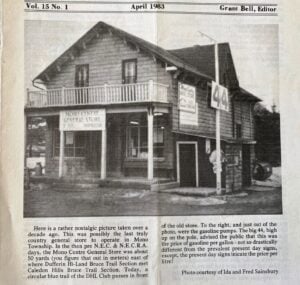
The Mono Centre General store ( Mono Cliffs Inn ) was a stop off point for hikers to pick up supplies, and even get a room upstairs for the night.
Check your bookshelves
I am trying to complete the DHL Library of all of the guide books. We are still missing edition #2,3,4 5,8 and 12. As we travel this summer a good source is small town bookshops. Have a look
Thank you,
Bryan Foley
DHL Archivist
This is wonderful Bryan, thank you, it gives such a depth to the place we love. Jane