
DHBTC Environmental Stewardship Award
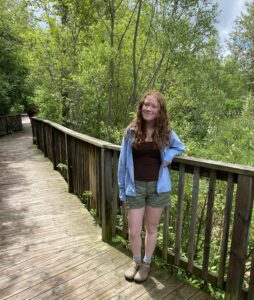
DHBTC presents its inaugural Environmental Stewardship Award to ODSS Grad – for the full article: Environmental Stewardship Award
American Chestnut Project Update
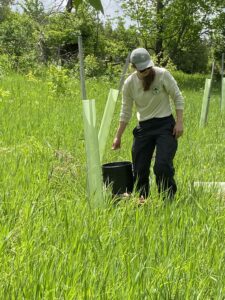
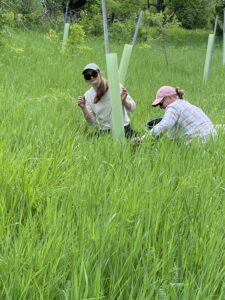
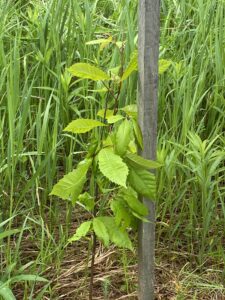
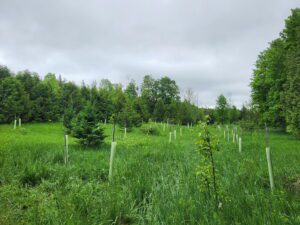 We’re thrilled to report that twenty-one months, more than two-thirds of the American Chestnut saplings planted on the Russel property are surviving. On June 6th, a group of Biodiversity volunteers, under the guidance of Mara McHaffie, BTC Ecologist and Land Stewardship Coordinator, met to monitor, replace tree guards, and mulch around the trunks of these still-vulnerable young trees. This is but one Biodiversity project designed to restore native habitat and bolster the local ecosystem. Thank you to the volunteers who help to make this happen!
Read the backstory by clicking American Chestnut: A Revival Project and scrolling down.
Restoration and Regeneration at Pine River Parking Lot
by Liz Jansen
May 2026
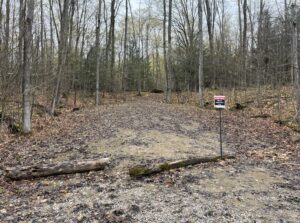
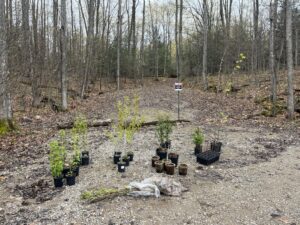
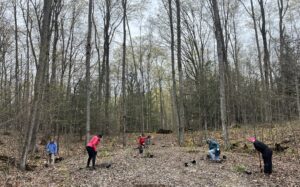
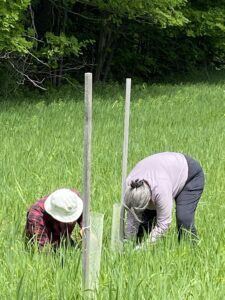
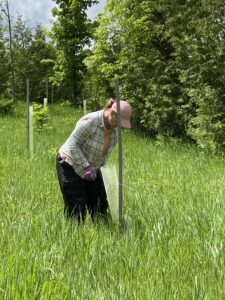
May 14 th saw habitat restoration under the guidance of BTC Restoration Project Specialist, Lyndsey Wilkerson. Seventy-three trees and shrubs from ten different species were planted at the newly graded Pine River parking lot to help fill in canopy gaps and discourage invasive species from settling in. The focus was on mostly tree species like birch and hickory but shrub species like elderberry and sumac were also included to add more options for foraging animals.
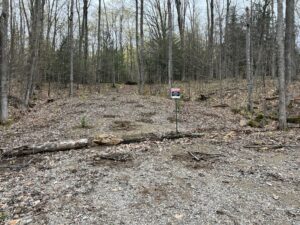
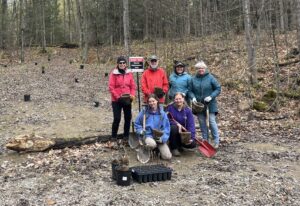
Thank you to the volunteers who helped with this project!
Putting Regenerative and Restorative Studies into Practice
by Liz Jansen
May 2026
On May 14, Grade 11 and 12 students from Orangeville and District Secondary School’s (ODSS) Greenhouse Class, along with members of the
school’s Green Association for Environmental Activism, a.k.a. GAEA (pronounced Gaia) Club, both headed by Kurtis McMurray, Head/Lead;
Canadian and World Studies, put regenerative and restorative ecological studies into practice. Mara McHaffie, Ecologist and Land Stewardship
Coordinator for the Bruce Trail Conservancy (BTC), guided students through two projects: one designed to replant native species in decline and the other to remove invasive species and create space for native species to grow.
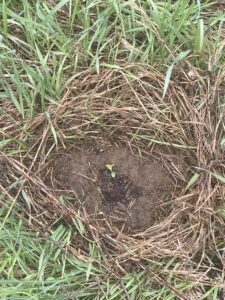
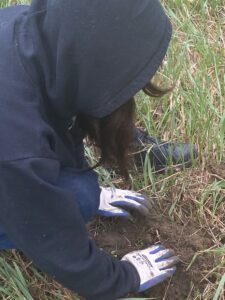
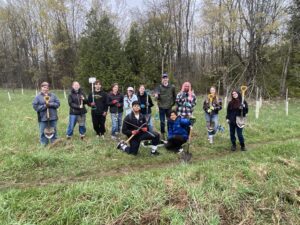
A BTC plantation and meadow restoration project on the Russel property became the new habitat for seedlings raised in ODSS’s greenhouse. Students disembarked from the bus, protectively guarding tender seedlings. After Mara emphasized the importance of their initiative in helping to improve ecological integrity and reverse biodiversity loss, she provided a brief description of the projects and students set to work. Monarch caterpillars eat only milkweed so supplementing their habitat helps reverse their dramatic decline. Seedlings and seeds were planted throughout the meadow and plantation to improve the health of the ecosystem.
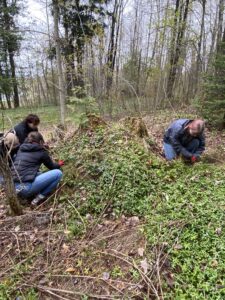
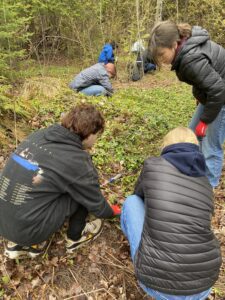
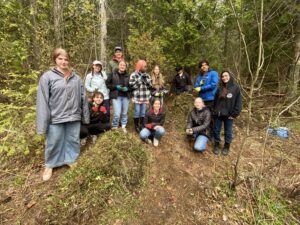
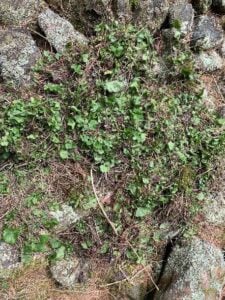
Across the road at Rock Hill, students removed invasive periwinkle to allow space for native species to thrive. Periwinkle is native to parts of Europe and Asia, but not North America. Like other invasives, it crowds out native species and turns a diverse ecosystem into a monoculture, affecting flora and fauna that depend on local species. As the periwinkle was cleared, it was gratifying to identify the emergence of horsetail and trout lilies which had been competing for their own space and now had space to spread their roots and thrive.
Thank you to all who participated. It makes a difference for all of us!
Garlic Mustard Pull with the Toronto Scouts
by Liz Jansen
May 2026
When a group from Toronto Scouts inquired about coming up to Dufferin Hi-Land Bruce Trail section last year in 2025 to participate in removing invasive garlic mustard from Honeywood Ridge, we didn’t hesitate to accept their invitation. The forested hillside is rife with the invasive species, imported when cattle in the adjacent pasture once had access to the area. However, the massive ice storm which blew through just weeks earlier had damaged trees, making access unsafe. Garlic Mustard is best removed before it blossoms. Left on its own, the prolific invasive crowds out native species and turns diverse ecosystems into monocultures which in turn adversely affect native flora and fauna. Although we had to scuttle our plans, we set our sights for 2026.
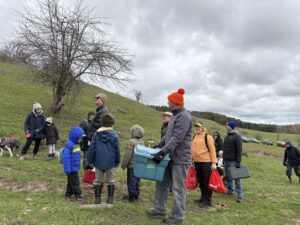
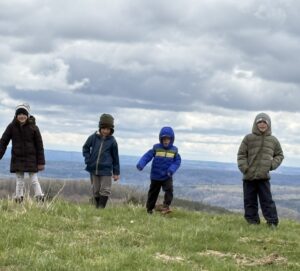
On May 2nd , despite the early-morning snow cover, a hardy and enthusiastic group of Beavers, Cubs, and their adults arrived to tackle the task. This was no run-of-the-mill garlic mustard pull. Grant Wigle, a.k.a. Hawkeye, Contact Scouter for the 433rd Toronto Beavers, came organized with a camp stove, propane tank, and water for hand-washing! Of course, all supplies had to be hauled approximately one kilometre up a significant grade to our designated muster point, situated in a clearing marking the start of our target area.
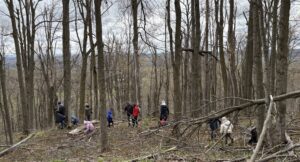
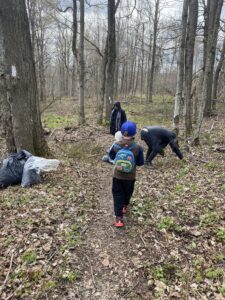
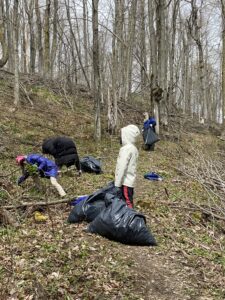
Once in the forest, the enthusiastic group set to work clearing garlic mustard from a swath within 10 feet on either side of the trail. Fallen branches and uneven terrain complicated the task but did not deter the hardy crew. Although the going was slow, everyone pitched in,making noticeable progress as we followed the trail down the treed ridge. Identifying native habitat brought meaning and intrigue to inquisitive participants when they realized that their work was reclaiming space for these plants to survive.
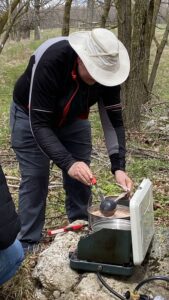
As noon approached, Hawkeye made his way back up to the muster point to prepare our meal.
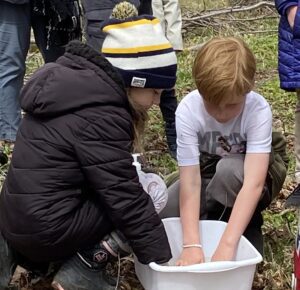
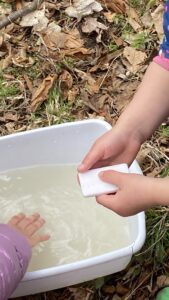
After removing eight large plastic bags of Garlic Mustard, all were treated to hot water and soap for hand-washing, hors d’oeuvres, hot chocolate, and hot dogs!
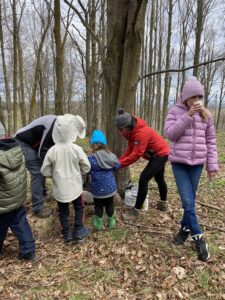
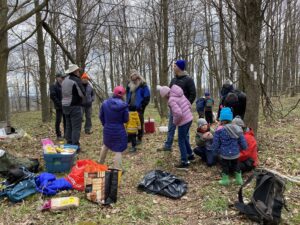
Best of all was the camaraderie that grew from a meaningful job well done. We’re already planning for next year’s return.
Thank you to the Beavers and Cubs from 433 rd Toronto Beavers.
Community Collaboration for Biodiversity
by Liz Jansen
May 2025
The Biodiversity Committee, members of the BTC and various community groups have been working hard to enhance biodiversity in our section this spring.
The spring season kicked off with a “train the trainer” event hosted by staff from Dufferin County Forests. An enthusiastic group headed out to the Mono Tract to learn best practices for garlic mustard removal. This set the team up for our first garlic mustard pull event with students from Orangeville District Secondary School (ODSS).
During Earth Week, approximately forty (40) grade nine geography students arrived on a cloudy, but warm day to remove garlic mustard from the Boyne River School property.
During the two kilometer hike into the site, students were introduced to the Bruce Trail and discussed the importance of invasive species removal. Arriving at the pre-determined spot, students started pulling, and pulling and pulling. Their hard work resulted in removal of large quantities of garlic mustard. ODSS intends this collaboration to become an annual event.
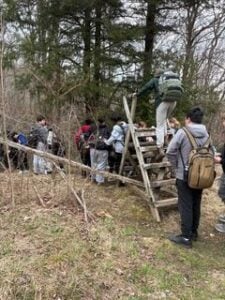
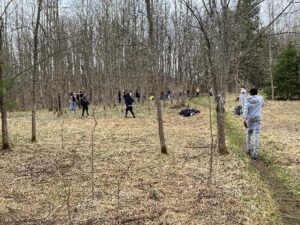
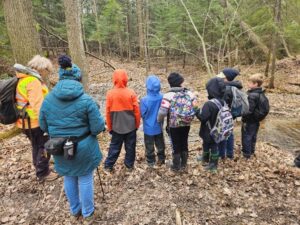
Despite all the garlic mustard removed by the students, there was still more to pull. Thankfully the Orangeville Scouts were keen to assist with this monumental, ongoing task.
A small, enthusiastic group of Scouts (aged 9 – 11) joined us on a cool, damp Saturday morning and undertook the task with gusto. The ever-curious youngsters asked questions throughout the event and helped the Biodiversity team remove even more garlic mustard from the Boyne River School site.
Unfortunately, a Garlic Mustard Pull with another group of fifty Scouts at a different project had to be cancelled because the ice storm had made the trails unsafe to use.
In Fall 2024, Dufferin Hi-Land’s Biodiversity team and ODSS students participated with the Bruce Trail Conservancy to establish a Seed Orchard at Splitrock Narrows property.
Together, we planted trees, shrubs and under-story wildflowers. This spring, twenty-eight (28) Grade 9 Science students helped plant the expansion of the seed orchard, as well as hike the property learning about ecosystems, local flora and fauna (with iNaturalist app), and the interconnectedness between humans and our environment. Approximately 110 plants of 16 different species were planted. A special surprise was the installation of the “official” Seed Orchard signage at the site.
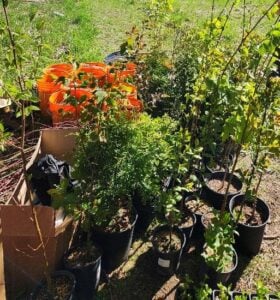
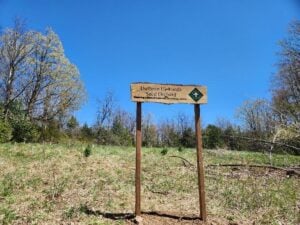
Thank you to all the community organizations who have helped make this spring season a productive one in preserving a ribbon of wilderness. Your hard work and dedication are greatly appreciated.
Do you or someone you know work with a community organization that would like to get involved? If so, please contact us: biodiversity@dufferbrucetrailclub.org
American Chestnut: A Revival Project

Article contributed by: Cathy Hughes
In the early 1900s, the Carolinian forest (which includes the Dufferin Hi-Land area) was home to the American Chestnut tree (Castanea dentata). The American Chestnut could live up to 500 years, grow to over 100 feet tall, and produce between 3,000 – 6,000 nuts per season! These majestic trees played an integral role in both the ecosystem and the economy. Woodland mammals and birds had shelter and a reliable food source. The timber was used for barns, houses, and furniture.
This marvelous tree species is believed to have made up twenty-five percent of the trees in the Southern Ontario forests (an estimated two million chestnut trees). Unfortunately, by the late 1940s, the chestnut population was decimated, with only small numbers of isolated trees remaining. Most recent surveys estimate only 2,000 American Chestnut trees remain in Ontario, firmly entrenching it as an “endangered species” under the Ontario Endangered Species Act.
What happened?
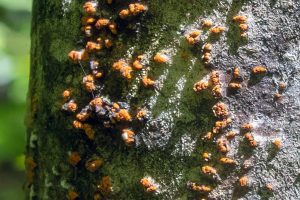
An accidental introduction of fungal disease Cryphonectria parasitica, commonly known as “Chestnut Blight” occurred. American Chestnut trees have no natural resistance to the blight. Once infected, the leaves, branches, and stems die off. The roots often remain unaffected and new shoots will resprout, however, the new growth becomes infected, and the sprouts do not survive. Some sprouts will survive long enough to flower, but if there are no other chestnut trees nearby to pollinate with, no viable seeds are produced. The cycle continues.
What’s being done?
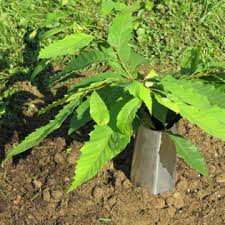 In 1998, The Canadian Chestnut Council (CCC) was established. This charitable organization’s mission is “to help restore the American Chestnut tree to areas of Canada it once occupied.” To achieve this, the CCC is working with the University of Guelph to produce fungal resistant American Chestnut trees of a Canadian origin.
As a result of successful American Chestnut plantings on other Bruce Trail Conservancy BTC) protected areas, the CCC is providing the BTC with 120 trees, to be planted within Dufferin Hi-Land Bruce Trail Club (DHBTC) boundaries. The DHBTC Biodiversity Committee hosted a tree planting event on September 14, 2024.
“Alone each of us can do a little, together we can do much.”
For more information: The Canadian Chestnut Council and Dufferin Hi-Land Bruce Trail Club.
iNaturalist Project
 Join the Bruce Trail project on iNaturalist and collect biodiversity data. Cataloging your observations helps track invasive species, identify new species, and record native species. This provides detailed, relevant, and scientific data on which to base effective stewardship strategies.
Making this valuable contribution is as simple as downloading the iNaturalist app, joining the Bruce Trail Project, and uploading photos and audio recordings during your hike.
Learn more at: brucetrail.org/what-we-do/#iNaturalist
 Rally your friends and family and get ready to hike, laugh, sweat, and conquer 25 km through the picturesque and peaceful Boyne Valley.